
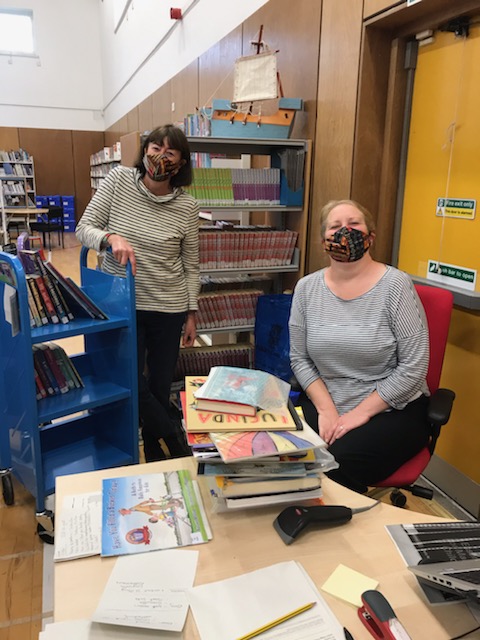
Bookworm Blethers with….. Maggie Burns

As part 2 of our World Book Day Book Blethers I am delighted to welcome the very lovely, helpful and generally wonderful librarian, Maggie Burns, to Unicorns and Kelpies.

Hi Maggie. Could you introduce yourself and tell us a bit about what you do?

I am Maggie Burns and I am a librarian for the Learning Resource Service for Falkirk Children’s Services. We are a small school library service with only myself and the principal librarian, Yvonne Manning. I have worked in this role as a children’s librarian for nearly twenty years and I support teachers, schools and ELCs to embed a reading culture in their settings, provide books and resources to support the curriculum, develop information literacy and help schools develop and run their libraries.

What are the best things about your job?

The most obvious favourite thing about my job is that I get to read lots of children’s books – although I would like to make clear that this reading happens in my own time not while I am at work! In spite of what some people think I do not sit and read books all day (talking to you, sister-in-law!).

I love reading and am incredibly passionate about books but what I really love about being a librarian are the relationships you develop with your customers. I like to think of myself as a bridge between the book and the child or teacher. I believe there is no such thing as a child who doesn’t like reading – they just haven’t found the right book yet. It is my job and passion to get the right book into the hands of the right child. A lot of what I do is supporting teachers in their work but I love visiting schools, meeting children and inspiring them to read. When you hear a child say ‘I don’t normally like reading but I’m going to read this!’ or when a teacher takes you aside in astonishment to tell you that you have inspired a reluctant reader, that is what I live for.

What books did you love as a child?

As a child I read voraciously, anything and everything I could get my hands on. If I didn’t have a book to take to the loo with me (I like reading on the loo!) I would pick up the shampoo bottle and read the back of it. My mum bought us books and took us to the local library and the big favourites were Enid Blyton and Roald Dahl. I also loved myths and legends, fairy and folk tales from other countries and I think this is why I now love fantasy. One of my favourite authors was Joan Aiken and my favourite book ‘The wolves of Willoughby Chase’. I still love it and it lives in me as only the special books from our childhood can.

What recent children’s books would you recommend?

Ah, this is a tough question because it depends on who you are recommending it to. One book does not fit all and, as a librarian, I really try and keep my personal preferences to myself. I recommend according to the child or class in front of me and I never denigrate someone else’s personal choices. I do try to guide and introduce so that the child who ‘only reads David Walliams’ is encouraged to try something else. Or the teacher who reads the same books with their class every year is supported in trying something new. Now that I’ve been all librariany about things I’ll tell you who I love at the moment.

Sophie Anderson is amazing and I love her stories because they are just the sort of thing I loved as a child. Last year my favourite book was ‘Orphans of the Tide’ by Struan Murray, I just adored the world-building, the characters, how tension was built and the fantastic twist that I didn’t see coming.

At the moment I am reading lots MG LBGTQ+ books as part of the #FalkirkReadingTeachers book group that the wonderful Kirsty helps me with. I love that children’s books can take big themes and make them accessible to children and help us to understand other people. Yesterday I read ‘A kind of spark’ by Ellie McNicol and both loved the story and increased my understanding of autism. You can learn about all sorts of things about neurodivergence or racism or refugees or LBGTQ+ but a good story lets you walk in the shoes of people who live it, at least for a little while. For anyone with a younger relucant reader who likes gaming and Youtube I recommend the HiLo series by Judd Winick and the Bunny vs Monkey graphic novels by Jamie Smart.

What were your favourite subjects at school?

I’ve always loved books and liked English literature at school but I adored geography and that is what my degree is in. I liked studying the relationship between people and the land we use, how man has shaped it and how it has shaped us. When I graduated I was a bit directionless. After working in stressful, low-paid jobs for a few years I reevaluated things and went back to university to become a librarian and I have never looked back. Librarianship appealed to me because of my love of reading but also my love of libraries, where I spent many hours as a child avoiding going home and associate with them with fun and safety. I think there is a common perception that librarians all have degrees in English Literature but, in my personal experience, the best librarians studied different subjects and can bring a wide-range of skills and experiences to the role.

How important is it for children to be encouraged to develop a love of reading for pleasure?

Developing a love of reading in children is a lifelong gift that I feel honoured to be a small part of. I am a working-class girl from a small town in Northern Ireland, raised during the troubles. My parents left school early, without any qualifications but they were readers and instilled a love of reading in me – this has made the biggest difference in my life and is why I am so passionate about children reading and libraries. Give your child the gift of reading, start reading to them from day one and don’t stop. To develop a love of reading a child needs choice and role-models. Be the reading role model in their life and take them to the library so they are exposed to the widest variety of books.

Reading also helps us to understand ourselves and the world around us, to develop empathy, to de-stress and escape, to grow our minds, to connect, to find the answers to life’s big questions, to imagine and, I like to think, makes us better people! This is what makes reading special and, like so many readers, I have found great comfort and solace in reading over the past year.

Thank for taking the time to join us, Maggie! I loved reading your replies! You can follow the Falkirk Learning Resource Centre on Twitter @Falkirk_LRS

Bookworm Blethers with….. Emily Ilett

  • Tell us a little bit about your debut book, The Girl Who Lost Her Shadow, that was published in 2019.

The Girl who Lost her Shadow is an adventure story for 8-12 year olds about a girl called Gail who is searching across a Scottish island for her sister’s missing shadow. Her sister, Kay, has depression, and Gail is sure that if she finds her shadow, everything will go back to the way it used to be. But her journey across the island is treacherous and she’s not the only one looking for Kay’s shadow… This is a story about conservation, mental health and sisterhood, filled with the salt and ripple of sea creatures.

  • What has been your journey to becoming an author?

As a child I loved writing and reading but it was through studying art at uni and being playful with materials and ideas that I gravitated back towards writing in my twenties. After my degree, I began to experiment with how the small, strange stories I had in my fingertips might grow, and a few years later I did a Creative Writing course. One of the stories I wrote during that year got stuck in my head so I worked on expanding it into a book just to see whether I could make it to the end. It was really a challenge to myself but I submitted it to the Kelpies Writing Prize and amazingly won in 2017 and The Girl who Lost her Shadow was published two years later! (I should add that at this point I’d already had a couple of rounds of rejections from agents so that this description doesn’t deviate from the resilience-demanding reality too much!). I think a huge step towards *feeling* more like an author for me was joining my local writing group and learning more about great initiatives like Write Mentor.

  • Are you working on any writing projects at the moment?

I am! My work in progress has a missing librarian, two scary Tree Monsters, one pair of feet, Ogham runes, a fierce friendship and a whole lot of weird and wonderful mushrooms

  • What is the best part about being a writer?  What are the most challenging aspects?

This is a tricky one! I think the two best parts about being a writer are: new discoveries and school visits. For my WIP, I have been researching mushrooms which has brought me so much joy during lockdown – my daily walks became treasure hunts as I searched for Inkcaps, Jelly Ears, Candlesnuff Fungus and Turkey Tail. I love writing about the natural world because it is the spark I need to look closer and deeper and let my unwieldy curiosity lead me to interesting discoveries. For The Girl who Lost her Shadow, I learned about underwater sea creatures like the impossibly heavy Sunfish and the super cool Hagfish (which has it’s own celebration day in October after being maligned for being ugly.)

And school visits mean that I get to chat to young people about what they’re reading, what they’d recommend I should read (I come away with massive lists!) and I get to share my love of reading too.

I would say the most challenging aspect is resilience. Writing is tough and sometimes it’s hard to keep going for lots of different reasons but especially when facing knock-backs or disappointments. Joining writing groups and connecting with other writers helps with this and the children’s writing community in Scotland is wildly creative, supportive and encouraging.

  • What books or authors did you love as a child?

I loved Robin Jarvis’ series, like the Deptford Mice trilogy and Tales from the Wyrd Museum. I remembered them as terrifying and dipped back into them recently, only to be terrified away again… Tamora Pierce was another favourite, especially her Alanna series and The Circle of Magic. Philip Pullman’s Northern Lights has a special place on my shelf and it’s one I will forever return to.

  • What current children’s books / authors would you recommend?

I have constant towering TBR piles because there is so much amazing children’s literature being published today! There are too many to name but a few favourite reads are The Deepest Breath by Meg Grehan, Pet by Akwaeke Emezi, A Kind of Spark by Elle McNicoll, Lampie and the Children of the Sea by Annet Schaap, Little Bits of Sky by S E Durrant, The Girl who Speaks Bear by Sophie Anderson and High Rise Mystery by Sharna Jackson. Big shout-out to fellow Glasgow-based writers Dean Atta, Lindsay Littleson and Maisie Chan. Dean and Lindsay are amazing YA and children’s writers and I’m looking forward to Maisie’s new release this year!

  • Did you always love to write? What was your favourite subject at school?

I liked English and Art but I also liked Maths (big algebra fan) and I loved that tiny moment when we got taught about stars in Physics. I’ve always enjoyed writing and playing with words and metaphors, but I think visually so it’s often a picture or drawing that sparks a new idea.

  • As a writer, how important do you think it is that children and young people develop a love of reading for pleasure?

I think stories offer so much: an escape, a refuge, a spark, a spirit, an aspiration. They can also offer the words to put to a feeling or experience that a child might otherwise find hard to place or talk about. Childhood can be quite a lonely and complicated place to be, and stories can offer friendship during that time.

Thank you for this brilliant blether, Emily! I am so pleased you could join us. To find out more and to follow Emily on social media have a look at the links below.

Twitter: @EmilyRIlett

Instagram: @pinecone_fish

Website: www.emilyilett.com

Bookworm Blethers with…. Tina P Schwartz

I am very excited to welcome author and literary agent, Tina P Schwartz, to today’s Bookworm Blethers. Thank you for joining us from the USA, Tina.

  • Tell us a little bit about yourself and your books.

I have 10 traditionally published non-fiction books for children and teens. The most recent one is called DEPRESSION: The Ultimate Teen Guide, and it deals with symptoms and coping mechanisms (both healthy and unhealthy) and gives many teens’ personal stories on dealing with depression.

  • Are you working on a current writing project at the moment?

I’m working on three books simultaneously, two non-fiction titles for adults and one novel for teens. The novel for teens is about a senior in high school who receives a lacrosse scholarship, then has an accident and goes blind and has to totally reinvent herself! Hopefully a gut-wrenching, page turner… that’s my goal!

  • What books or authors did you love as a child?

S.E. Hinton was the first author that got me to go to the library and see every book she had written, after reading THE OUTSIDERS. I love her! In my teens, I was totally into Stephen King, too!

  • Did you always love to write? What was your favourite subject at school?

As a kid, I didn’t like to read because I was very slow. Once I got into authors I loved, I read more and more and got better and better. I did like writing, it was one of the subjects in school I excelled at, fortunately. I’ve kept journals since I was young.

  • As a writer, how important do you think it is that children and young people develop a love of reading for pleasure?

Being a reader is key to being a writer. You must read and write every day, train like an athlete!

Thank you so much for joining us Tina. You can find out more about Tina’s writing and her literary agency below.

LinkedIn:  TinaPSchwartz

Twitter: @tinaPschwartz

Facebook: Author Tina P. Schwartz

Websites: www.tinaPschwartz.com and www.ThePurcellAgency.com

Bookworm Blethers with…… Alastair Chisholm

I am delighted to welcome author of Orion Lost, Alastair Chisholm, to today’s Bookworm Blethers. Thanks for joining us Alastair!

  • Tell us a little bit about yourself and your books.

I’m an Edinburgh-based author / computer geek. My first published picture book was The Prince and the Witch and the Thief and the Bears. I now have three picture books, plus my first children’s novel, Orion Lost, a sci-fi mystery adventure. I’ve also written a bunch of puzzle books for children and adults.

I live with my wonderful wife, two wonderful (if infuriating) teenagers, and a cat named Maudie, who is right now telling me she hasn’t been fed, though I know for a fact that this is a lie because I got up very early this morning to feed her.

  • Orion Lost is a science fiction adventure.  Are you a big fan of sci-fi?

Absolutely, and I always have been. As a kid I devoured lots of old sci-fi writers – Isaac Asimov, Robert Heinlein, John Wyndham, Nicholas Fisk and others, and loved them. There are different kinds of sci-fi, but my favourite is the type that uses futuristic ideas to set up human stories – like Star Wars, or Star Trek, or Doctor Who (I love Doctor Who).

  • Are you working on a particular project at the moment?

Ooh, loads! I’ve just finished the final edits on my next science fiction novel, Adam-2. That’s going to proof soon, for release in August, which is very exciting. I’ve been writing a series of books for younger children all about dragons (yay, dragons!), which will also hopefully be out this year. And I’m working on a new science fiction novel and two picture book projects. I’m living on coffee and optimism.

  • What books or authors did you love as a child

The book I loved the most was The Grey King, by Susan Cooper – I literally read it until the cover fell off. It’s part of The Dark is Rising series, and what I loved was that there was this adult story going on in the background. It was the first time I’d read a book where the adults felt real. I loved that whole series. I loved Robert Westall, too (The Machine Gunners, Fathom Five and many others), Nicholas Fisk (Trillions), anything by John Wyndham (The Day of the Triffids), and of course the awesome Dianna Wynne Jones. I was a real bookworm! (Also comics – I loved 2000AD and still do).

  • What current children’ s books and authors do you recommend?

One of the best things about becoming an author is I get to read tons of kids’ books and say it’s work.

Kirsty Applebaum has great ideas and heart, and I loved Troofriend. Damien Love’s Monstrous Devices is brilliant and dark, and if you want to get your geek on then Dashe Roberts’ Sticky Pines series (starting with The Bigwoof Conspiracy) is laugh-out funny and deceptively clever. Also, anything by Fleur Hitchcock! And a bit older, but Darren Charlton’s Wranglestone is awesome too. Oh, and so much else – Tom Huddleston, Christopher Edge… there’s an unbelievable amount of good reading out there.

  • Did you always love to write? What was your favourite subject at school?

I did always like writing stories, and I suppose English was my favourite subject. But I was always quite geeky too and loved computers, so I tended to be a bit split. I suspect my English teacher always thought I spent too long describing the space ship mechanics, and my Maths teacher wished I didn’t keep writing story ideas in the margins.

  • As a writer, how important do you think it is that children and young people develop a love of reading for pleasure?

As a writer, I think it’s vitally important that young people develop a love of reading my books, available at all good bookshops, because then I can keep doing this job 😂.

Seriously though, reading opens up the universe. It introduced me to other people and ideas in a way that nothing else ever has. Books stay with you – characters, stories, descriptions, single lines can stick in your head and change the way you see the world.

And not just books – I’m a huge comics fan, and audiobooks are good, too. And yes, there’s a lot of great tv out there J. But the key thing is the story. Absorb stories wherever you go. Think about how they make you feel. When you meet and talk to other people, ask yourself what their story is. Ask yourself what they think your story is.

You can find out more about Alastair by checking out his website and following him on twitter and instagram.

Twitter: @alastair_ch

Web: http://www.alastairc.com

Instagram: @alastairchisholm

Bookworm Blethers with….. Sue Hampton

Today I am delighted to welcome Sue Hampton to Bookworm Blethers. Put your feet up, have a wee read and enjoy!

  • Tell us a little bit about yourself and your books.

I left teaching (which I loved) when I was first published 13 years ago, and wrote many books for children and teenagers before branching out into adult fiction, long and short. My stories are historical, contemporary and speculative, real-world and fantasy, funny and sad. I’ve been booked as a visiting author by about 600 schools. I’m now a grandma and have lived with Alopecia Universalis since 1981. My latest book is for Extinction Rebellion and features poetry as well as short stories and other prose about climate and peace activism.

  • I love how you talk about swerving bandwagons on your website.  Why do you think that is important?

I’ve never been one for fads and fashions, and think the book trade should be more concerned with good writing than with cashing in on the latest celeb or trend. I also believe in the power of stories to develop empathy and broaden horizons, so I write about love, loss, relationships and emotions – the human condition – regardless of what’s currently selling and even within contexts that are fun and magical.

  • What books or authors did you love as a child?

Stories that embrace sadness like The Snow Queen, and Frances Hodgson Burnett’s The Secret Garden and A Little Princess. Lord of the Rushie River by Cecily M Barker was my first real passion around the age of six or seven. I was a Malcolm Savile fan a little later and enjoyed the Jennings books more than Enid Blyton but was a sucker for horse-based fiction at one point: Josephine Pullein-Thompson?

  • Are there any contemporary books / authors that inspire you?

As a children’s author, Michael Morpurgo, whose stories captivated my Y3 and 4 classes and moved them almost as much as they moved me! My favourite living adult author is Susan Fletcher, of Eve Green and House of Glass, because her writing is so deep, compassionate, sensual and poetic. I also admire Barbara Kingsolver, Carol Shields, Anne Tyler, Elizabeth Strout and Marilynne Robinson. I like character-driven novels and don’t mind a lack of plot or pace.

  • Did you always love to write? What was your favourite subject at school?

Yes. I won a few writing competitions as a child and was top in English at secondary school. My English teacher was about as gifted and inspiring as a teacher can be.

  • As a writer and as a former teacher, how important do you think it is that children and young people develop a love of reading for pleasure?

I think it’s vital, and it saddens me when reading and writing are reduced to technical, assessment-driven tasks that kill the joy of words and stories. I understand that 49% of adults in the UK didn’t read one book last year, which means they missed out on SO MUCH. I’m a big reader and have learned a lot from fiction – about the world, including places I’ve never been, and the past, and about people and myself. A certain ex-US President claimed not to have read a book since the age of seven, which may explain his underdeveloped emotional intelligence! Imagination enriches childhood. I experienced the power of Story Time at the end of the primary school day. Joyously assessment-free and a shared emotional experience, it gave children a reason to read.

Thank you so much for taking the time to join us, Sue!

Find out more about Sue and her work on her website and by following her on Twitter.

http://www.suehamptonauthor.co.uk

@SueHampton

Bookworm Blethers with……. Robin Scott-Elliot

A massive welcome to Robin Scott-Elliot for today’s Bookworm Blethers.

Tell us a little bit about yourself and your books.

I’m a sports journalist turned children’s author – I spent more than 25 years living in London and writing about every sport you can think of. I was lucky enough to travel the world covering football in Brazil, Olympics in Australia and Russia, cycling in France but my favourite events were right here – the London Olympics and Paralympics and the Glasgow Commonwealth Games.

After the Glasgow games in 2014 I moved home to Scotland with my partner and children. We live in Helensburgh on the Firth of Clyde, just over the hill from Loch Lomond, a beautiful part of the world. I was desperate to write so Karen suggested we’d swap roles – she would go back to full-time work while I would stay home, look after the kids, freelance and try and write.

It was our daughters, Iona and Torrin, who made me write a children’s story. I’d never considered writing for children but something clicked, both on the page and in my head. I like adventure stories – love the idea of being taken somewhere else, somewhere exciting, dangerous maybe, taken on an adventure, and so that is what I wanted to write. Add that to a lifelong love of history and that’s me. I like looking for corners of history that might be undiscovered by many people – both my first two books were set in times I knew little about until I began to research the background.

My first book was The Tzar’s Curious Runaways – the tale of three children, Kat, Alexei and Nikolai, escaping the court of Peter the Great and his Circus of Curiosities and fleeing across Russia.

Next was The Acrobats of Agra, set in the Indian Rebellion of 1857, about Bea, Pingali, Jacques the acrobat and his circus tiger hunting across India for Bea’s missing brother. It was chosen as one of the Observer’s Children’s Books of the Year for 2020. I’ve read the Observer since I was a student (a long time ago!) so to see my book in its pages was a surreal experience. I had to keep looking just to check it was really there.

Where do you get your inspiration from?

I find this a difficult one to pin down. I get much of my inspiration from books. I read a lot of history simply because I’m interested in it and then stumble over something and that sets me off towards my story. For the Tzars Curious Runaways I read of Peter the Great’s Circus of Curiosities and that struck me as an intriguing starting point. For the Acrobats of Agra I was reading an old history of the Indian Rebellion. In a chapter on the siege of Agra, the author mentioned in passing that a French travelling circus was also caught in the city and that leapt out at me… a travelling circus trapped in a siege – now that is demanding to be made into a story.

I’m currently working on an idea about Robert Louis Stevenson and his American stepson, Sam. Again I read something written as an aside – that Stevenson drew a map of an island with buried treasure to keep Sam occupied during a wet summer holiday in Braemar. From there grew the story of Treasure Island – imagine, I thought, seeing all that happen from Sam’s perspective. It also gives me the chance to write a story set in Scotland because I do find indirect inspiration here.

I grew up hearing my granny’s stories of the Isle of Mull or my Mum’s stories of the lochs and glens we drove through on the way to stay with granny. I find the west coast and the Highlands such an inspiration, it’s beautiful but forbidding, mist hanging low in the glens, hills rising above, higher and higher, ruined castles, cleared villages, birds of prey circling high above, the wildness of the coast – it sets the imagination free, encourages you to make up stories.

Are you working on anything exciting at the moment that we can look out for?

My new book, Hide & Seek, published again by the wonderful Everything With Words, is due out this summer. It begins in Paris in 1942 and the elevator pitch would be something like… ‘When Amelie Dreyfus shuts herself in her mother’s wardrobe it’s a game; when she comes out it’s a matter of life or death. With her family taken, Amelie has to fend for herself in Nazi-occupied France – she has no choice but to resist.’

Like my other books, it’s fast-paced (I think pace is vital in adventure stories), full of danger, sad in parts, scary in parts with a lead character you are willing to survive – or at least I hope you are! I think Amelie is my favourite character of all I’ve written. She has to survive on her own in an adult world in which one mistake could cost her her life.

What is the best part about being a writer?  What are the challenges?

When you’re actually writing, just writing, when you disappear into your story. It could only be for 10 minutes or it could be for an hour, but you come out and realise you’ve been away – and then you get excited about the book and think I love this story, this one is really going to work. Then, sure enough, along comes the doubt… it’s an odd existence, absolutely a rollercoaster ride and you most certainly have to make the very most of the ups because the downs – rejections (lots of them), self-doubt and all that – are tough. Of course, they’re not tough compared to what so many are going through and it does feels a privilege to be a writer (it’s what I’ve always wanted to be – since I accepted I was dire at football!), but they are still your hurdles and you often have to find a way over them on your own. 

What books or authors did you love as a child?

I’ve always enjoyed stories steeped in history. Eagle of the Ninth was a favourite – I must re-read it – and I liked DK Broster’s Flight of the Heron series about Jacobite Scotland. Ring of Bright Water by Gavin Maxwell was a story I loved. I read the Diary of Anne Frank while we lived in Holland – it’s such an important book for all generations. I worked my way through the Swallows and Amazons books, although I probably enjoyed the recent biography of Arthur Ransome, his spying and his Soviet connections more. Writers were more interesting back then!

Herge’s Tintin holds a special place for me – my dad was in the army and I grew up in Germany, Belgium, Holland so was sent home to Scotland to boarding school. Before getting on the plane to Edinburgh (with one of those ‘Unaccompanied Minor’ ticket holders hung around my neck) my Mum would buy me the latest Tintin – over the course of the term I would read it again and again. I loved his adventures and where they took you, even if he was the world’s least productive journalist!

What current children’s books / authors would you recommend? 

When you go into a bookshop, say the Waterstones on Sauchiehall Street in Glasgow, the choice of children’s books wows me every time. My daughters love meandering through the shelves (that cover is so important for the first hook!) and always come away with something. I feel quite envious of them! Because I think this is a golden age for children’s books – there really is a book for everyone out there. Be it picture, chapter, fantasy, classic, contemporary, historical, factual, graphic – I recently read RJ Palacio’s White Bird, which is fantastic. 

Me and my eldest (13) are big fans of Emma Carroll – historical fiction at its best. Lindsay Littleson and Eve McDonnell are also well worth a look in that genre. Cane Warriors by Alex Wheatle is high on my wishlist as that’s a time in history I want to know more about. Katherine Rundell is of course consistently excellent, Wolf Wilder is my favourite of hers (Russia and the revolution in particular are one of my history hotspots).

My youngest (11) is a big fan of Juliette Forrest – she got me to read Twister, which is excellent. I love a book with a real breathless pace.

My eldest is now branching into YA and Elizabeth Wein’s Codename Verity and Rose under Fire left me drained. They are both stunning and really are so hard to put down – you fear so much for the central characters you worry if you stop reading something bad might happen to them! She also made me read Holly Jackson’s Good Girls Guide to Murder, such a cracking whodunnit. I’m just starting Richard Lambert’s Wolf Road, which has had so many good reviews. So many fantastic books, so much choice…

Did you always love to write? What was your favourite subject at school?

I have always enjoyed writing – I was one of those kids (and am now one of those adults) to whom numbers made no sense but words always did. It was actually writing about sport rather than stories that I was first really interested in. I used to write imaginary football reports. Becoming a journalist seemed a natural progression and I loved being a journalist. I think the discipline of journalism helps with longer-form writing – I’m used to having my work edited (sometimes drastically!) and used to working to deadlines.

Guess! History. I think so much depends on the teacher. I had interesting and interested history teachers – my English teachers weren’t (and one accused me of plagiarism after a short-story writing competition – never forgave him!). There was one exception, he had an attic classroom in the school and made us stand on our desks to recite First World War poetry – it stuck with me and I still read it.

As a writer, how important do you think it is that children and young people develop a love of reading for pleasure?

I’m always surprised when I meet adults who say they don’t read because it has given me so much joy. But then I think that older generations did not have the choices that are there for children today and nor was what seems, hopefully, to be a growing acceptance in schools of the importance of reading first for pleasure. I see my daughters’ teachers encouraging them to read for pleasure and that makes me so happy. If you don’t start reading for pleasure – and any form of reading counts – then why would you go on reading when you are not compelled to for school? It’s why school librarians, teachers, and beyond them local librarians and booksellers, are so, so important – there is a book for everyone but sometimes the reader needs help to find it. Start by reading for pleasure and you will be a reader, of some sort, for life. At least I hope so.

Thanks for taking the time to join us for today’s Bookworm Blethers, Robin.

Find out more by checking out Robin’s website,

http://www.robinscottelliot.com/

Bookworm Blethers with…… Sinead o’hart

I am so delighted to welcome Sinead O’Hart to Saturday’s #BookwormBlethers. Thank you for taking the time to join us, Sinead.

For anyone who is not familiar with your books, tell us a little bit about The Eye of the North and The Star-Spun Web.

The Eye of the North was my first book, and it’s a story about a girl with no friends and a boy with no name who must work together to save the world… or, that’s how I usually pitch it, at least! It’s the story of Emmeline Widget, who is logical, scientific, practical, and precise, and a boy who calls himself Thing, who is scattered, easy-going, friendly, and street-smart. They run into one another by chance, becoming fast friends. When Emmeline is kidnapped, Thing tries to help her – thereby setting off on an adventure that takes him to the heart of an ancient glacier, where Emmeline’s parents, and Emmeline herself, are caught up in a terrible plot to raise a mythical Creature from the ice. It’s set mostly in Greenland, and features fantastical beings, the Northern Lights, airships, and a heroic dogsled team. The Star-Spun Web is the story of Tess, who has grown up under the care of Misses Aurelia Ackerbee and Rebecca Whipstead in Ackerbee’s Home for Lost and Foundlings, completely unaware that she has an incredible power: she can travel from her own reality into other realities. When a man named Mr Cleat comes to claim her from her happy home, Tess decides to go with him in the hope that she can finally learn who she is, and where she comes from. But Mr Cleat seems to have his own reasons for wanting to ‘care for’ Tess, and they involve using her power to bring danger across the worlds…   

Where do you get your inspiration from for your stories?

From anywhere and everywhere! Mostly, from reading other stories and having my imagination sparked by the brilliance of other writers. I also love to ‘people-watch’; I think authors are people who are interested in people, essentially, and I love to observe others, without being rude or nosy, to discover how my fellow humans tick. I love getting ideas from funny words, from misspellings on road-signs, from asking myself questions, from things that occur to me while I’m daydreaming, and from the things I’m interested in, like mythological creatures, folklore, history, science, and so much else. Ideas are everywhere, just waiting for us to spot them!

Are you working on anything exciting at the moment?

My next book is being published in June – but I can’t tell you anything about it yet! It’s called Skyborn, and I’m very excited that it’s almost out in the world. I’m already working on my fourth novel for my publisher, Little Tiger Press, and that should be coming out next year. I’m also working on lots of other projects, in the hope of selling them to publishers – everything from full-length Middle Grade novels to picturebooks, and I keep all my ideas safely written down so that I don’t forget them. Notebooks are vital to any writer!

What is the best part about being a writer?  What are the most challenging aspects?

The best part about being a writer is the fact that you get to use your imagination. I always wanted to work at a creative job when I was a little girl, but for a long time I wasn’t quite sure what sort of creativity I liked best. Turns out, I love creating whole worlds – and the people who live in them – from my head! That’s a magical feeling. And the challenging aspects? Turning off your inner critic, that little voice inside your head that sometimes tells you you’re not good enough. Everyone is good enough. Anyone who wants to write stories, no matter who they are or where they’re from, should give it their best shot, tell the stories they want people to read, and write for their own enjoyment. Don’t let anyone – especially yourself! – tell you you’re not good enough.

What books or authors did you love as a child?

My favourite book as a child is still my favourite book today – Alan Garner’s Elidor, first published in the 1960s (though I didn’t read it in the 1960s, as I wasn’t alive then!) I also loved A Wrinkle in Time by Madeleine L’Engle, The Phantom Tollbooth by Norton Juster, The Little Prince by Antoine de Saint-Exupery, The Hounds of the Morrigan by Pat O’Shea, Michael Scott’s books about Irish mythology and folklore, and Enid Blyton’s tales of boarding school life, Malory Towers and St Clare’s

What current children’s books / authors would you recommend?

So many! This is a wonderful time for children’s writing. I love the work of (among others): Vashti Hardy, Juliette Forrest, Jennifer Bell, Philip Pullman, Robin Stevens, Celine Kiernan, Kieran Fanning, Alex Bell, Alex English, Claire Barker, Nicola Skinner, Nicola Colton, David Roberts, Gareth Jones, Guy Bass, Catherine Doyle, Helena Duggan… I could literally go on forever! Librarians and booksellers are great people to ask about book recommendations, if you’re stuck.

Did you always love to write? What was your favourite subject at school?

Yes, I did always love to write. One of my earliest writing memories happened in primary school, very early on, when my teacher would encourage me to make a story by writing one verse of a poem and then asking me to write the next verse, until we were finished. I wrote all through my childhood, but only for my own enjoyment – I never thought I would ever get to do it as a job. I wanted to be a scientist when I was small! As a teenager I wrote a lot of poetry, and when I was about 20 I started to try to write novels (which were terrible). It took another 15 years after my first attempt before I managed to write a book which I didn’t think was awful – and that one turned into The Eye of the North. I always loved to read, and I particularly love to read children’s books. I read children’s books all the time (even though I’m *very* old!) My favourite subject at school was a tie between Art and English. I loved them both and got exactly the same marks in those subjects when I was leaving secondary school.

As a writer, how important do you think it is that children and young people develop a love of reading for pleasure?

Oh, my goodness. So, so important. Reading for pleasure has defined my entire life. I was an early reader, and I devoured books. It was always my favourite thing to do for fun, and it still is. I love reading a story and letting my imagination play with the words; I love picturing the world, and the characters, and watching it unfold in my head. Reading has brought me years of joy, and now I get to immerse myself in stories in an entirely different way, by writing my own books – but I probably wouldn’t be a writer now if I hadn’t been a reader in my childhood. If you’re someone who doesn’t like books, it’s always worth trying audiobooks, or graphic novels (comic books); reading through images and art is just as wonderful and immersive as reading through words. It’s also good to ask teachers or librarians or booksellers for recommendations, as they usually know exactly the right story to get you hooked! Reading is a wonderful magic. It stretches your imagination, gives you a wonderfully flexible and creative mind, and helps you to think and dream and empathise with others. It couldn’t be more important.

Thank you for your inspiring responses, Sinead!

Find out more about Sinead and her fantastic books by following her on the links below.

www.sjohart.wordpress.com

www.twitter.com/SJOHart

www.instagram.com/sinead.ohart

Bookworm Blethers with….. Sylvia Hehir

Today we have YA author Sylvia Hehir joining us on Bookworm Blethers. I love the sound of the Love and the Village series.

Tell us a little bit about yourself and your writing.

 I live in the west highlands of Scotland and I mostly write contemporary YA fiction set in this fabulous location. Deleted and Delivered are the first two books in the Love and the Village series. They are fun reads with relatable characters and a touch a romance. My debut novel, Sea Change, is a page-turning YA thriller. 
You’ll also find a free Valentine’s, Love and the Village short story on my website and on Wattpad. 

You write mainly young adult books.  What is it that appeals to you about writing for this age group?  

It is a time of life that stays with you, isn’t it. Everything turned up to maximum. All those things experienced for the first time. Plus, I’ve been a teacher in secondary schools for over thirty years so I have spent a lot of time with teenagers. I loved reading the Georgia Nicolson stories (as an adult!) and I dream of writing like Louise Rennison. 

What is the best part about being a writer?

Well, you get to make up stories – so that is brilliant. And when a story has shunted its way around your head until you know it’s not going away – you just have to write it down to get some peace. 
The main challenging aspect is having to write it down! That’s when the words in your head suddenly find somewhere to hide.  
Another fab part is that I usually work from home, and with living in such an amazing place, I can walk out of my door to see stunning views. 

What books or authors did you love as a child? 

Enid Blyton – almost exclusively. Other than that, I only had comics to read at home and any other books I did read were generally at school. 

What current children’s/YA books / authors would you recommend?  

Goodness. So many nowadays!  The big names will always find their way on to lists but why not try Maisie Chan, Pete Kalu, Keith Gray, Sarah Broadley, and my chum at Garmoran, Hayleigh Barclay. 

Did you always love to write? What was your favourite subject at school? 

You have to remember school was a long time ago for me! I wasn’t a particularly engaged scholar, although I loved Biology at secondary school. I was quite skilled at dissection! I did do English Literature and Language to A level, so I must have enjoyed writing a bit at least. 

As a writer, how important do you think it is that children and young people develop a love of reading for pleasure? 

I’m currently reading my old Roobarb and Custard Annual to help cheer me up. Reading other things is important too, but enjoyment is a priority for everybody. And if that starts as early in life as possible – then so much the better. 

Thank you, Sylvia, for your brilliant answers. I’m off to check our all your author recommendations!

To find out more about Sylvia and her work, follow the links below.

www.sylviahehir.com 

Twitter: @shehir853

Facebook: @shehir853  

www.garmoranpublishing.com 

Sylvia Hehir Bookshop UK 

Bookworm Blethers with…. Cath Howe

I am very excited to welcome the lovely and talented author, Cath Howe, to Unicorns and Kelpies today for Bookworm Blethers. Thank you for joining us, Cath!

For anyone who has not read them, tell us a little bit about your first books, Not My Fault and Ella on the Outside.

My stories are contemporary Middle grade. Someone used the term ‘tricky tweens’ for the age group as my books are read a lot in years 5.6 and 7. 

Ella on the Outside is the story of a new girl who arrives in a school desperate to make friends but holding a family secret she is scared will come out. Ella suffers with childhood eczema too which affects her confidence. She makes some bad choices and another girl in her class puts her under pressure to spy on someone. Things get messy, for a while. It’s a story about finding the strength to be who you are.  

Not My Fault is a story told by two narrators. They are sisters. A year before the story starts, there’s an accident and Maya’s leg is injured on a roundabout. Her sister Rose was pushing the roundabout and Maya blames her for the accident. They no longer get along. Now they must set off on a school journey to an activities’ centre by the sea. And Maya is in an angry mood which is getting worse. Who knows what she might do on the school journey? 

Your latest novel, How to Be Me, is set to be pubished in the spring. What is it about?

How To Be Me is the story of Lucas who is “super rich, super shy and super lonely”. It’s the summer holidays and Lucas is often alone in a vast house with only the new au pair for company. Lucas often feels he’s not the right son for Dad. He feels awkward and stuck. Dad tells him he needs to speak up for himself more. He has enrolled Lucas in a local drama club. Lucas can’t think of anything worse! 

The club and the children he meets turn out to be the start of a huge change in Lucas.  

Where do you get your inspiration from?

I’m a trained teacher and work a lot in schools so I get to know a lot of children of the age I write for.  

I’m interested in messy lives. All of us have messy lives, to some extent. I think it’s good to be honest about some difficult stuff. I’m also an optimist- I love to show how a life can be transformed.  

I find inspiration everywhere. I often write dialogue first. I love chance comments overheard on the bus and anything to do with live theatre. 

What is the best part about being an author? 

The best part is when a child tells you how your book made them feel and talks, or writes to you about it.

What books or authors did you love as a child? 

I loved Noel Streatfield, Dr Seuss and adventure stories. 

What recent children’s books have you read that you would recommend? 

I love the books of SE Durrant, Morris Gleitzman and David Almond.  I have also really enjoyed Nizrana Farook’s The Girl Who Stole An Elephant, Kirsty Applebaum’s The Middler and Sylvia Bishop’s The Bookshop Girl

Did you always love to write? What was your favourite subject at school? 

I always wrote and illustrated poems and stories as a child. My favourite subject at school was Art. 

As a writer and teacher, why is it important that children and young people develop a love of reading for pleasure?

I think reading for pleasure is vital. Books can be a safe space to explore new worlds and ideas and they have always been a haven for me.

Thanks so much for your great answers and for taking the time to get involved, Cath! I am very much looking forward to reading How to Be Me.

Find out more about Cath and her books on her website or by following her on twitter.

http://www.cathhowe.com

Twitter: @cath_howe

The Dragon and Her Boy by Penny Chrimes

A suffocating blast of hot air blew up from below, enveloping the fairground, blowing the women’s skirts up like balloons and scorching the hairs on the men’s shins. It felt like it came from a pair of great bellows deep underground. It sounded like a sigh, a groan of immense weariness, and it smelled of bad eggs and something long-buried.

I am delighted to be taking part in the blog tour for Penny Chrimes’ new book, The Dragon and her Boy because, let’s face it, who doesn’t love a dragon story and it turns out that this one is up there with the best. This is a book that grabs you from the first moment you spot the beautifully enticing front cover and it does not let you go.

It is the summer of ‘The Great Heat’ in London and street urchin, Stick, and his tumbling friends Spud and Sparrow, are trying to earn a few pennies from the Bartholomew Fair crowd with their skills.

When the ground starts shaking and hot air comes bellowing from under the streets below, panic ensues and when the dust has settled Spud and Sparrow are nowhere to be seen.

Stick’s determined to find his friends and his search leads him through a crack in the ground taking him into the darkness below. It is here that he meets the dragon.

Initially wary of one another, Stick is determined to help the dragon find a place of safety and so an unlikely friendship begins.

One of the things I loved about this book is the world that Penny Chrimes has created for her characters, the same world that her first book, Tiger Hear was set in. It is a London from a history that’s not quite ours with Dickensian vibes.

The Dragon and her Boy is an adventure built on friendship, bravery and loyalty. It is full of warmth mixed with darkness, and excitment coupled with emotion. Overall, an exciting, charming adventure that will tug at the heart.

Thank you to Hachette Children’s for inviting me to be a part of the blog tour.

Children's Book Reviews

Design a site like this with WordPress.com
Get started