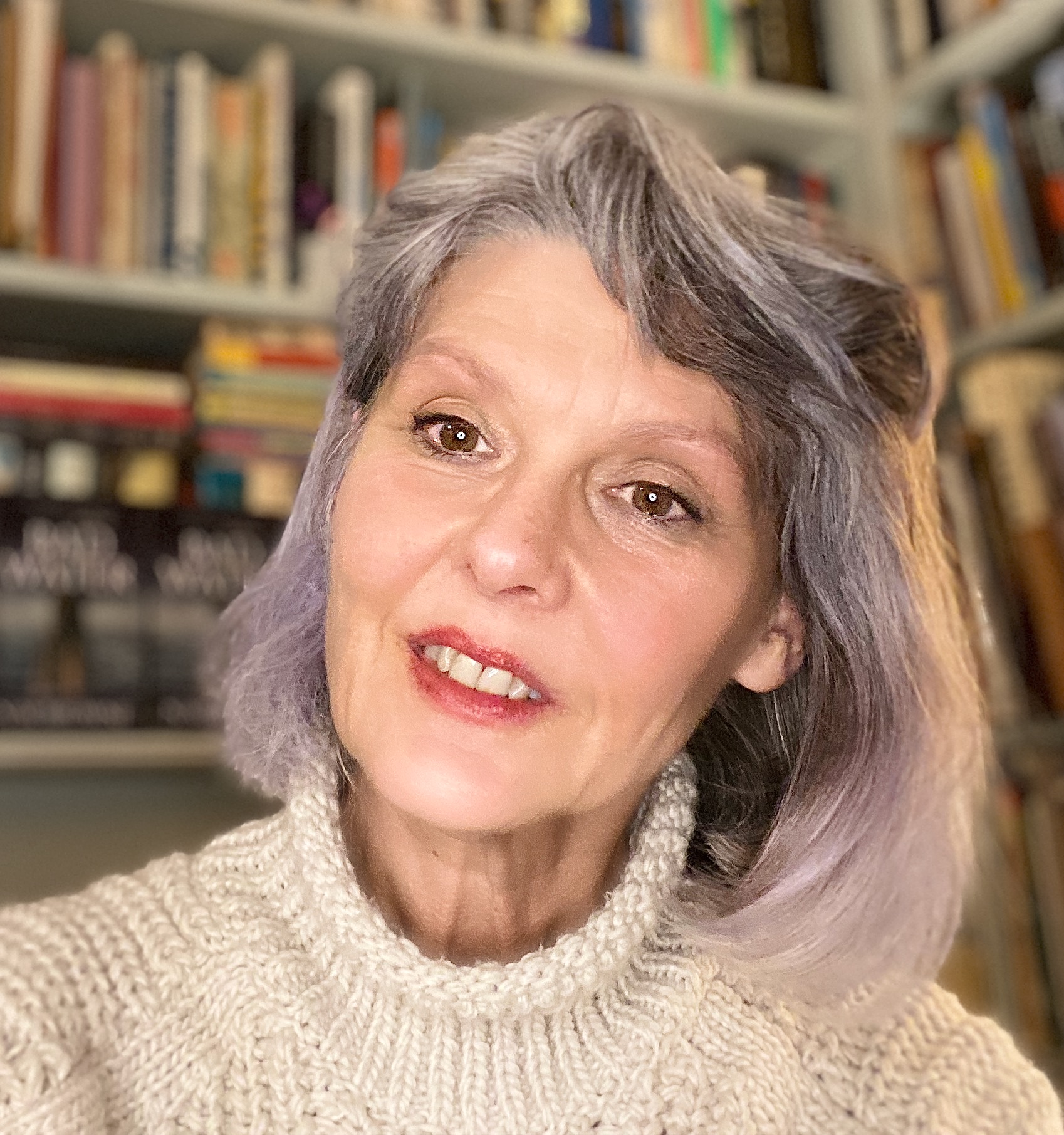
Bookworm Blethers with …… Lindsay J Sedgwick

A big Saturday Bookworm Blethers welcome to author Lindsay J Sedgwick! Put the feet up and have a wee read of this brilliant chat.

Tell us a little bit about the Wulfie: Stage Fright and your new book, Wulfie: Beast in Show.

When my daughter, Libby, was little, I created the Wulfie stories for  her at bedtime, on and off for a year or so. She’s now 21, so (for writers out there) don’t give up!

The Wulfie series is published by Little Island Books and they centre around Libby (10) and her best, most mischievous friend, Wulfie. Libby lives with her absent-minded inventor dad, step-mother Veronika and Veronika’s 10 year-old son Rex – and it’s not much fun. Rex’s favourite hobby, when not bullying her or getting her into trouble with Veronika, is making up scary stories so she won’t sleep. His current range involves a version of the Big Bad Wolf who swallows little girls – never boys – slowly, finger by finger. Libby decides she’s tired of being scared; she goes looking for the BBW. Instead, she finds Wulfie in her great great grandfather’s old trunk.

Wulfie is a purple wulfen which means he can talk and grow as large as a house or tiny as a mouse. He’s also capable of and willing to swallow anyone who’s mean to his new best friend, Libby. (Especially Rex.) The books are a series of adventures for the duo, in which Wulfie – by trying to help or being curious – generally makes things worse. With each book Libby emerges stronger and with new skills and confidence – much to Rex’s irritation.

In Stage Fright, Rex makes sure she can’t audition for the school play so Wulfie goes instead. He gets the part of the Big Bad Wolf, a part that Rex believes should be his, and gives her name…

For the second book, Beast in Show, I’ve created my nastiest villain so far, Rex’s Aunt Ilda. Ostensibly a dog breeder, she kidnaps Wulfie, wanting to win a show dog award she has coveted for years… Can Libby find a way to outwit her? Absolutely, but it won’t be easy!

Both books are illustrated by Josephine Wolff.

What is your overwhelming feeling when you have a new book coming out?

Overall delight, but also relief, and a bit of nervousness. Relief that it has made it to publication, delight that a story important to me is now out there, on bookshelves, and will be enjoyed – hopefully – by lots of people. Nervousness that I might have missed something on the last edit, that it isn’t as good as it could be or, with my non-fiction book (Write That Script) that I might have got something wrong!

Are you working on any new projects at the moment?

I’m playing around with a new series for 6-9 year-olds; it’s an idea I’ve wanted to write for years and involves a type of time/ world travelling. Really excited to get my teeth into that, but right now the main focus is the Wulfie series. I’m waiting for edits on the third Wulfie book (it’ll be out in Sept) while finishing draft 1 of book 4 (which will be out Spring 2022).

I’ve also been writing a TV adaptation of one of my novels that I’m very excited about and there’s an adult novel waiting in the wings. I usually work on a number of projects at once – I find it helps to move between stories and styles when one project is acting up!

What books or authors did you love as a child?

The main series I remember was Susan Cooper’s series The Dark is Rising. I had to wait 2.5 years to get all five books (for birthdays and Christmas). I did love Enid Blyton when I was younger  – especially The Magic Faraway Tree while AA Milne’s books of poems (When We Were Very Young, Now We Are Six) had fantastic rhymes that I remember still. I loved the magical elements of The Once and Future King by TE White … when Merlin turns young Arthur into a fish, a bird etc in order for him to learn lifeskills – I mean, wouldn’t that be a great way to homeschool?

I also loved history and mythology so there were lots of books such as I am David (Ann Holm), Hitler Stole Pink Rabbit Judith Kerr), the Mary Renault books about ancient Greece. And the best comic of all – Misty, full of tales of the supernatural.

My mother made sure there were always books around and I moved pretty quickly on to books of hers that might have been considered too old for me. I read Colette’s Claudine books, for example, from the age of 11/12.

Are there any contemporary books / authors that you would recommend to everyone?

I loved the debut of Eve McDonnell, ‘Elsetime’ last year and Rooftoppers by Katherine Rundell. E R Murray’s Nine Lives series is great too. I wish I could offer more suggestions but I don’t tend to read many kids books when I’m writing them – once I move on to an adult novel that’s waiting in the wigs, I’ll dive back in and might have a longer list. There really are some brilliant books out there and as my daughter grew up, she passed me books so I became a fan of YA fiction too.

Outside of children’s writers, Barbara Kingsolver and Elizabeth Strout (esp Olive Kittredge and Olive Again) are truly wonderful writers.

Did you always love to write? What was your favourite subject at school?

Probably predictable, but yes and I loved inventing worlds and making up secret societies; even tried to host a séance when I was 10. I wrote my first book when I was nine and then did books of poems for my mother for birthdays. I came at the end of a large family so I learnt to entertain myself; writing and reading were a big part of that.

In school I loved History, Maths and Art. With history, it was the lives lived element I liked rather than battles or wars… I think I got that from my mother, although both my parents had also been in WW2; my dad in the RAF and my mother in the WAAF so that probably contributed to my interest.

As for Maths, I ended up being one of the first seven girls to do honours maths in our school – which seems mad now but I did my Leaving Cert in 1983. It was really hard and I’m sure some of the motivation was stubbornness and not wanting to be a traditional ‘girl’ ( I refused to do Home Ec!) but at least, if you got the maths right, it was right.  I think I liked that certainty. While Art was pure escapism, and is to this day!

I hated the way English was taught in secondary school. My essays got lots of ‘please come back down to earth’ and ‘this was meant to be a factual essay’. Our teacher seemed clearly hated being a teacher and the subject; she always wore the black gown and did the absolute minimum of teaching. I really wonder now what happened to her and what made her that way… I might have to put her in a book to find out.

How important do you think it is that children and young people develop a love of reading for pleasure?

Absolutely critical – and it doesn’t matter what they read. I’m addicted to the feel of actual books but if they read books online (as my daughter mostly does) that’s fine too, or if they read fan-fiction or comics or books of odd and wonderful or gory facts… I think reading is good for the brain but it’s also the easiest way to escape whatever is happening around you, if only for a while.

But writing is the same – I think children’s imaginations need to be nurtured. I had a wonderful teacher in my last two years of primary school called Mrs Boyle who really encouraged both my writing and my mad imagination; along with my mother, I think I’m a writer because of her. Teachers are just so important at that stage – I was very lucky to have had her.

Thank you for joining us for a brilliant chat, Lindsay!

To find out more about Lindsay and her work, check out the links below.

Twitter: https://twitter.com/LJSedgwick

Instagram: https://www.instagram.com/lindsayjsedgwick/

Facebook: https://www.facebook.com/LindsayJaneSedgwick.Writer

Website: www.lindsayjsedgwick.com

Bookworm Blethers with….. Justine Laismith

A great big Bookworm Blethers welcome to today’s guest – author, Justine Laismith.

Tell us a little bit about yourself and your books.

I grew up in Singapore and later came to London to study Chemistry. Since completing my PhD, I have worked in the pharmaceuticals, chemicals and education sectors. When I was in industry, I wrote scientific papers and reports. While I did write fiction occasionally, it really only took off around the time I returned to Singapore in 2010. There I entered a local writing competition. As winner, my children’s book The Magic Mixer was published by Straits Times Press. It’s a fun chapter book about a harried mother who wants to stay one step ahead of her children’s antics. Also a woman-in-STEM, she experiments with the Magic Mixer to give herself animal abilities. But choosing the right animal proves more difficult than she thought.

When I’m not writing, I enjoy taking pictures of architecture and nature. They help me crystallise my thoughts on my story setting. For example, my tween book Secrets of the Great Fire Tree was penned after a trip to China. Published by Aurelia Leo in 2019, it’s about a boy left behind in the mountains. Desperate to bring his mother home, he harnesses the secrets of the Great Fire Tree. Even when its sinister power brings tragedy, he pushes on.

I really love the sound of Secrets of the Great Fire Tree. Where does your inspiration for your stories come from?

Lots of places! When I come across something fascinating, whether it’s from reading, watching a show, or talking to people, I want to find out more. Over time, these pieces of information weave themselves into a story.

For example, I read about a social issue in China, where migrant parents find work in the city but the children are left-behind in the rural homes. Some return to visit only once a year for Chinese New Year, others don’t return for ages. One particular story moved me. They reckoned this boy was about six years old. He was living alone in the mountains with only a pig. You can read more about this account here:

https://justinelaismith.wordpress.com/2019/11/10/left-behind-children/

Another time, in a social gathering, the subject of a popular exotic dish came up. I discovered the delicacy Buah Keluak comes from a poisonous fruit. Even more fascinating is the elaborate process of removing its poison before they end up on our dinner table. You can read more about it here:

https://justinelaismith.wordpress.com/2019/11/01/warning-about-eating-from-the-dangerous-keluak-tree/

At the UNESCO World Heritage Centre Singapore Botanic Gardens, I saw unusual trees with melon-sized fruit dangling from the trunk with the thinnest twigs. I later learnt this Cannonball tree is a sacred and healing tree.

https://justinelaismith.wordpress.com/2019/11/02/cannonball-tree/

These facts learnt over three random occasions morphed in my head and Secrets of the Great Fire Tree was born.

What is the best part about being a writer?  What are the challenges?

I have always enjoyed forming words on a blank piece of paper. There’s something about being able to find just the right word. Whether it’s fiction or scientific reports, I get a lot of satisfaction being able to express myself using words and letters.

Coming up with a good plot featuring compelling characters is the most challenging part of writing. I am very attached to my characters and it breaks my heart to see them suffer. As a result, I struggle with creating obstacles for them.

What books or authors did you love as a child?

I loved folklore. I believe folklores open windows into a culture. Everywhere I went, there was always one I hadn’t heard of. I could not get enough of them.

My favourite author was Enid Blyton. During Library Period at school, I found The Magic Faraway Tree and fell in love with it. Naturally, I completed the series. I went on to read her boarding school books. For a little Chinese girl in the Far East, toffee apples, picnics, midnight feasts and boarding schools were exotic.

Are there any children’s contemporary books / authors that you would recommend?

Loads! How much space have I got?

  1. Where the Mountain Meets the Moon by Grace Lin is great book that ties many Chinese folklore into a story.
  2. For medieval-like adventure, check out The False Prince by Jennifer Nielsen.
  3. For magical boarding schools, check out Keeper of the Lost Cities by Shannon Messenger
  4. For something quirky, go for Savvy by Ingrid Law or The Road to Ever After by Moira Young
  5. If you want a good laugh, try Fortunately the Milk by Neil Gaiman.
  6. A book with a big heart is Song for a Whale by Lynne Kelly.
  7. If you are looking for adventure books with STEM female role models, Vashti Hardy is the author for you.
  8. For a fantastical magical reading experience, I’d recommend Matilda Woods and Catherine Doyle.

This is only a small subset. I have lots more recommendations on my website.

https://justinelaismith.wordpress.com/book-reviews/specific-book-themes/

Did you always love to write? What was your favourite subject at school?

Yes. I wrote my first book before I was ten. I was very proud when I got my first work published. It was a poem about the Smurfs!

I didn’t have a favourite subject because I was lucky enough to like all of them. However I found languages the hardest. In English, I could cope with grammar but I did not to do well in writing composition. Chinese was even harder because we did not speak it at home. There were always Chinese characters I did not know.

Nonetheless, I am glad I persevered with them. As a writer now, I am reaping the benefits of working hard on my grammar. At school I might not be able come up with stories under the classroom constraints, but now, in my own time and environment, I am creative.

As for Chinese, being bilingual has opened up new avenues when I carry out Chinese-related research. Many a time I have found new information by searching in Chinese. This has helped me when I wrote Secret of the Great Fire Tree. My current project is a historical fiction with elements in ancient China history. Likewise, I have gleaned valuable information from Chinese websites and podcasts.

As a writer, how important do you think it is that children and young people develop a love of reading for pleasure?

Very important. Books open up our world and take us to a different place. Sometimes we escape to a magical land, or a real place we’d like to visit one day. Sometimes we find a character we can relate too. You are never lonely when you are with a book.

What a fabulous interview with some great recommendations too! Justine has pledged to give 25% of her royalties from the sale of Secrets of the Great Fire Tree to a children’s charity. Another reason to buy what looks like a fantastic book.

A massive thank you to Justine. You can find out more by checking out her website and social media links below.

Website: www.justinelaismith.wordpress.com

Twitter : @JustineLaismith

Instagram : @JustineLaismith

Facebook: http://www.facebook.com/JustineLaismith/

Bookworm Blethers with….. Malcolm Duffy

I am delighted to welcome YA author Malcolm Duffy to Bookworm Blethers. Put the feet up and enjoy!

Tell us a little bit about yourself

I was born in Newcastle-upon-Tyne quite a long time ago. Having had a fairly straightforward childhood, I ended up moving to London and getting a job as an advertising copywriter. Coming up with crazy ideas and getting paid for it. What’s not to like?

I now live in leafy Surrey, with my New Zealand wife, Jann, and daughters Tallulah and Tabi. I like lots of sport – tennis, running, cycling, swimming, skiing- but have yet to master any of them.

My first book is called ‘Me Mam. Me Dad. Me.’ It looks at domestic violence through the eyes of a fourteen year old Geordie lad. It’s gone done very well with children and adults alike.

My second book, ‘Sofa Surfer’, explores the world of the hidden homeless, the young people who move from house to house, sofa to sofa. This novel is also creaking under the weight of a lot of praise.

My new book is currently under construction.

What is that you enjoy about writing for teens?

I like writing for teens because I have two of them in my house, one thirteen, one sixteen. In seven years’ time I’ll be able to start writing adult books.

I also like writing for teens because it allows me to delve into a fascinating world that’s half-way between childhood and adulthood. Teens sometimes say and do things that are totally unique. I love trying to capture this in my stories.

You have tackled some pretty serious themes in your books.  Why do you think it is important that issues like homelessness and domestic abuse are featured in stories like yours?

I don’t think you should shy away from tricky subjects, especially in YA. You only have to turn on the news to see and hear some pretty horrible stuff. I feel it’s my job to take some of these serious issues and make them palatable, with a storyline that is both informative and entertaining. It’s a difficult tightrope to tread, but one I love climbing on to every morning.

Are you working on anything exciting at the moment?

I’m working on my third book right now. Which is very exciting. But I will probably be shot if I told you what it is. So I won’t.

I wrote a short film about dyslexia called Mical, which has had 1.26 million views on YouTube, You can add to the numbers by watching it here: https://youtu.be/1LJkJrCxgLE .

I’m working on a new short film which will hopefully go into development once lockdown ends. And Me Mam. Me Dad. Me. is in development through Lime Pictures, for a TV series. It will be great to be involved in that.

I’m also working on a TV comedy series with a writer friend of mine. Working on screenplays definitely helps with writing novels.

What is the best part about being a writer?  What are the most challenging aspects?

The best part of being a writer is the freedom to put on the page whatever you want. I spent years as an advertising copywriter, where I was working to a client’s brief. So to be able to put down my own words, in any order I like, and not get fired, is a wonderful feeling.

The most challenging aspect of being a writer is knowing nothing is ever good enough. I love the whole re-writing process, but I know deep down there are never enough re-writes to make something one hundred per cent perfect. 

What books or authors did you love as a child?

I devoured all the classics- Tom Brown’s Schooldays, The Swiss Family Robinson, Robinson Crusoe. But the book that probably had the biggest impact on me in my teens was ‘The Exorcist.’ Couldn’t sleep for days afterwards, but it showed the power of good writing.

What current children’s books / authors would you recommend?

I’ve just finished ‘Furious Thing’ by Jenny Downham, which I loved. Will definitely be reading more of her work. Other authors I enjoy reading are: Matt Haig, Sarah Crossan, Ele Fountain, Jonathan Tulloch, Ilsa J Bick and Anthony McGowan. There are plenty of great writers out there keeping me on my toes.

Did you always love to write? What was your favourite subject at school?

I have loved writing for as long as I can remember. I was writing little stories for my own amusement from about the age of six.

My favourite subject at school was, of course, English. I also really loved Geography. But for some inexplicable reason I went to University and studied Law.

As a writer, how important do you think it is that children and young people develop a love of reading for pleasure?

I think it’s vital that children and young adults develop a love of reading. A book can take you to places no film or TV programme can. Social media can be great, in small doses, but there’s only so much Tik Tok a brain can take.

I give a lot of talks in schools and try and encourage reading as much as I can. Saying you don’t like reading is like saying you don’t like food. There are so many types and styles out there, whatever your taste, there’ll be a book for you.

If you’d like to know more about me and me books go to malcolmduffy.com

Thanks for the brilliant chat, Malcolm. It was a pleasure to welcome you to Bookworm Blethers. Good luck with the new book and i look forward to finding out more about it!

Bookworm Blethers with….. N M Browne

A huge welcome to YA author, N M Browne, who joins today’s Bookworm Blethers. Have a wee read of her fabulous interview!

Tell us a little bit about yourself and your novels. It sounds like you have had a fascinating journey to becoming a writer.

When I was a little girl I wanted to write books and it was always an aspiration, but I didn’t actually write very much at all. I did a bit of journalism at University and then qualified as a teacher with the vague notion that I’d have time to write in the holidays. I didn’t of course. I was very much one of those people you meet at a party who tell you they always wanted to write a book, but had never found the time. I did an MBA and had a grown up job as a marketing executive for Shell. Then, just before I turned thirty my father died. He was a painter who had given up painting to teach in order to support us. He had just started painting again when he died. My sister (also a painter) bought me a psion – this tiny portable word processing device which cost her a fortune. As she pointed out if you want to do something, do it, because life is short. She was right of course and that fact, plus my guilt at her having spent do much money she couldn’t afford, got me writing.  I entered a few competitions and got absolutely nowhere. I also remember getting a heap of rejection letters from children’s publishers. Then I heard that Bloomsbury were starting a children’s list. I sent everything I had written to Barry Cunningham ( not the way to do it)  A few weeks later he phoned me up to arrange a meeting to discuss my ideas and commissioned me to write my first children’s book: a middle grade story called ‘the Extraordinary Lightening Conductor’ which I published as Nicola Matthews. When I wanted to write a novel I pitched the idea and the first few chapters to Sarah Odedina, who succeeded Barry at Bloomsbury. She liked it and so published my first children’s novel ‘ Warriors of Alavna’ and I became N M Browne. I got lucky. ‘Bad Water’ is my tenth published novel for children/YA

What is it that appeals to you about writing for the young adult age group?

I think the stories that you read when you are young stay with you forever. I have always read avidly, but the stories that shaped my thinking most are the ones I read as a child and so when I started writing they were the writers  and stories I most wanted to emulate. Writing for young adults allows you a lot of scope for sophisticated plotting, characterisation and world building, but it obliges you to focus on story and I love that. I love a good yarn. When I’m writing I lose myself in other worlds just as completely as I did when I was a child.

These days too, I feel teens have complicated, pressured lives and I want to remind them that there are other possibilities. The stories we tell ourselves change who we are, and my stories are always about young people being courageous and somehow making their little bit of the world better.

What is the best part about being a writer? What are the most challenging aspects?

The best part of being a writer is that you get to live in your imagination. I used to say you could work in your pjs too but that ‘s been true for many people for months.

I like the fact that you can make anything happen in a book – the only real limit is your imagination. People will talk about the market and about your personal brand, but I tend  not to think about either. I am still really excited by a new idea and a new character – there is no other feeling quite like losing yourself in a story. It’s frustrating when you can’t make it work but absolutely joyous when you can.

The most challenging aspect now is that it is harder to sell books now at every level. It is a very crowded market and though you hope a good story will sell itself, it is a little more complicated than that. It is demoralising if after all your hard work and passion, you can’t put the book into the hands of all the readers you are sure would love it.

What books or authors did you love as a child?

Oh pretty well everything I read. I grew up in a small town with no real bookshops and I was completely dependent on the school library and the local library. When I’d read all of my quota, I’d read my parents’ books so my taste was eclectic. So –  an abbreviated list:

 The Borrowers, Little Women, Anne of Green Gables, The Chalet School, the Narnia books, Biggles , ( Also Jennings and Just William)A Wrinkle in Time. Anything by Alan Garner, Andre Norton, Rosemary Sutcliffe and John Wyndham, also Francis Hodgeson Burnett. Once I left primary school I mainly read adult fiction mainly SF and historical – Ray Bradbury, Isaac Asimov, Anya Seton and of course Jane Austen. I’ve always been pretty eclectic.

What  current children’s YA books/authors would you recommend?

That is a tricky one as  a lot of former students and friends are all very busy writing brilliant books right now. I have enjoyed Angie Thomas, Patrick Ness and Francis Hardinge’s books a lot. I would also recommend Matt Killeen, Sue Wallman, Catherine Johnson, Tanya Landman, Ann Cassidy, Celia Rees. My friend AM Dassu has had a great debut with ‘Boy Everywhere’ for slightly younger children too. There is a lot of great writing out there!

Did you always love to write? What was your favourite subject at school?

Yes. I have always loved stories, telling them as well as writing them. When I was at school we did get chance to do quite a bit of creative writing so I didn’t do much at home. Instead, I read constantly and obsessively. When I was at primary school I didn’t do any maths for a whole year but read under my desk:  I rather think my teacher should have noticed. At secondary school  I loved English, History and Art.

As a writer, how important do you think it is that children and young people develop a love of reading for pleasure?

Reading has been an enormous source of pleasure in my life so of course I want to share that with other people. It fires the imagination, escaping into books can be adventure or  solace. It worries me that sometimes when children are taught to see books as codes that have to be broken, as work instead of fun. I also feel it is wrong to see people who get the stories from other sources from TV, film, games and graphic novels as somehow less sophisticated. They are all different varieties of story-telling, they all meet our deep human need for narrative.

Reading helps you to write, of course, and for that reason children who read a lot do gain an advantage in our culture, but there is no faster way to leach the joy from something than to make it worthy and useful. I’d like all children to be given the chance to find pleasure in books, whether they love them or not has to be down to them.

Find out more about Bad Water by having a wee watch of this video.

Find out more about N M Browne and her books:

Website: https://www.nmbrowne.com/

Twitter: @NMBrownewriter

Instagram: N_M_Browne

Blog: http://awfullybigblogadventure.blogspot.com/search?q=N+M+Browne

An absolutely enormous thanks to N M Browne for joining us. I loved reading your fascinating and very enjoyable interview and I am looking forward to getting stuck in to Bad Water!

Bookworm Blethers with….. Annemarie Allan

I am so pleased to welcome author Annemarie Allan to Bookworm Blethers. A massive thanks for joining us!

  • Tell us a little bit about yourself and your books.

I write novels for children and young adults, short stories and historical booklets on my local area (including witchcraft!). I never seem to be able to settle on one genre, but my books almost always include an element of fantasy.

My first novel, ‘Hox’ won the Kelpies Prize in 2007 and my third, ‘Ushig’, was shortlisted for the 2011 Essex Children’s Book Award. My most recent books, published by Cranachan Publishing are ‘Charlie’s Promise’ set in Scotland in 1938, which tells the story of two local children who help a young refugee from the I Holocaust to find a place of safety. Last year an updated version of my novel ‘Breaker’ was published. It deals with the issue of oil and plastic pollution in our oceans.

  • Where do you get your inspiration for your stories?

My inspiration is the people, the history, the legends and the natural landscapes of Scotland. Writing advice often says ‘write about what you know’, but I think that is really just the starting point for letting your imagination take flight.

  • What are you working on at the moment?

Like many other authors, the pandemic seems to have stopped me in my tracks, but I have managed to complete the final draft of a ghost story (yet another genre!). It’s a YA novel about Scotland’s first great witch hunt, which had a catastrophic impact on the area where I now live. I have also produced a short story for the ‘Stay at Home’ anthology complied by Cranachan Publishing and a number of other short stories. I have to admit, these came about largely because I didn’t dare turn up at my (now online) writers’ group without something to offer!

  • What is the best part about being a writer and what are the challenges?

One wonderful thing about writing for young people is that fact that you get to meet your readers via school visits and other events. They are so full of enthusiasm that visits like this are an absolute joy. Right now, of course they are virtual which is good but not nearly so good as face to face! I also love the fact that as a writer, you can let your daydreams fly and still claim you are working!

One of the greatest challenges for a writer is to have faith in themselves in the face of rejection. I spent 15 years sending stories to agents and publishers before anyone took an interest. It would have been very easy to just give up and sometimes I did, for a few months, but always came back to it. I didn’t want to be rich or famous, I just wanted readers!

  • What books or authors did you love as a child?

Fantasy has always been my ‘go to’ read. My most vivid memories are of CS Eliot’s Narnia books – I devoured them. I was only allowed two library tickets as a junior member and I had a deal with my brother that I could have one of his tickets for something we both might read, which is how I came across a series about Kemlo, a boy who lived on a space station, written by an author called E C Eliot. I looked him up to remind myself and discovered he had about 15 different pen names and produced rafts of books! But my most memorable writer is one I first met as a child that I kept reading as an adult was Andre Norton, hugely famous in the United States but not well known here. Fantasy again, of course!

  • What current children’s books / authors would you recommend?  

There are many children’s books on the market and much of it is very high quality writing. I would read absolutely anything by Frances Hardinge, I love David Almond. And if you are looking for great stories you can’t go wrong (shameless plug here) with Cranachan Publishing – small but mighty!

  • Did you always love to write? What was your favourite subject at school?

I have always loved words and language. I have been putting stories on paper since I was old enough to hold a pencil. My early attempts were almost direct copies of books I have read but I have improved a bit since then, I hope! I was rubbish at everything else at school. My primary 7 teacher told me I was a dreamer who would never amount to anything but that doesn’t worry me because I know that if I feel like it, I can always put her in a story!

  • As a writer, how important do you think it is that children and young people develop a love of reading for pleasure?

The thing about fiction is that you live a host of different lives in a multitude of different places, which might not even be on this planet or in this reality (yet another plug for fantasy!). It gives people the freedom to have experiences that might be denied them in real life, it encourages empathy, it widens your world view, so yes I do think it is hugely important. And I think people who are denied the opportunity (due to disability for example) should have someone reading to them or providing audio books or whatever it takes to give them access to the wide and wonderful world of books.

You can see me reading something I wrote about why books are important to me here:

What a fascinating chat, Annemarie! Thank you so much for joining us for today’s Bookworm Blethers. To find out more about Annemarie and her work check out the links below.

Website:             http://annemarieallan.com/

Twitter:               https://twitter.com/aldhammer

Facebook:          https://www.facebook.com/annemarie.allan.56

Bookworm Blethers with….. Nikki Young

A big Bookworm Blethers welcome to author, editor and creative writing tutor, Nikki Young. Thanks so much for joining us Nikki!

Tell us a little bit about yourself and what you do.

I’m Nikki Young and I write books for the middle-grade age range, which includes the 8/9 to 12-year-olds.

I come from a small town in West Yorkshire called Heckmondwike, which is a former mill town whose legacy from the industrial days of the Victorian era can still be seen. I am hugely inspired by the rich history of those woollen mill days – the Luddites used to meet in a pub just up the road from where my mum lives. Charlotte Bronte even wrote about this particularly turbulent time in her book, Shirley.

Talking of the Bronte’s, this is another legacy of my home area, as the Bronte family moved around a lot and had stayed in a few places local to me before settling at Howarth. I often imagined the sisters looking out over the moors and finding inspiration for their writing. I think I had fanciful ideas about doing the same thing!

My books are all set in the area where I grew up.

The Mystery of the Disappearing Underpants is based on the street I used to live on, where there was a house that we all considered strange, possibly haunted. In this story, three friends set about creating a secret agency so they can solve crimes during the summer holidays. They start by looking for Harry’s missing lucky underpants but soon end up being involved in something more sinister.

The Time School series, of which books 1 and 2 are currently available (the third on its way), is loosely based around the school I attended. In these stories, four friends in their first year of secondary school, get the opportunity to learn more about their school and town’s histories through short journeys back in time to different periods. Each adventure takes them back to a period that has significance to one of the characters so that each also has the opportunity to learn about their family history at the same time.

I think understanding the past is important if you want to understand what is going on in the world today. These books are short – they are only intended as a snapshot into past times – but they give an insight into times in history that children might not know about and hopefully, might inspire them to find out more. For example, book 2 features a Polish refugee and highlights the difficulties he and his family faced after the Second World War. Book 3, takes us back to the 1970s and the racial tension running high across the country at that time.

Tell us a little bit about The Storymakers Writing Club.

I set up Storymakers in 2017 following the publication of my first book. It was down to a need at the time – my middle daughter was in Year 5 and had been studying most of the year for secondary school entrance exams that take place at the beginning of Year 6. Needless to say, it is a particularly full-on year with little time given to creativity. I thought it might be fun, or interesting, to offer some creative writing workshops as an antidote to all that academic learning.

The workshops were a success, so I did more. From there, I went from offering workshops to weekly groups, splitting them into different age categories so I could include younger children (aged 7) and older teens. I currently have three groups that meet on a Saturday afternoon and one on a Wednesday evening, plus I’m doing an additional Vocabulary group on a Monday. All virtually, of course.

Over time, parents began asking me if I would do a 1:1 lesson with their child to help them with their writing. At first, I was reluctant – I am a writer by training, not a teacher. I worked for ten years as a freelance writer and copywriter whilst working on my novels. However, parents told me this was a reason why they wanted me to help their children. It is my writer’s background that appeals to them. They had also seen that their children enjoyed my lessons and were gaining from them. In 2020, when we went into the first lockdown, I saw an upsurge in parents requesting 1:1 lessons, which I continued to do, but online. This has worked exceptionally well for me because it has enabled me to work with children all over the country and even the world.

What has your journey been to becoming a writer?

I always said I would like to write a novel someday, but I didn’t know what I wanted to write. Not for a long time anyway. As a child, I wanted to be a journalist or a features writer for a magazine, but I ended up doing science A-levels, which I’ve never quite been able to work out why! I think at the time, there was a big push to get children to study sciences and I think I was somewhat coerced into doing it. At sixteen, I wasn’t the sort of person to push back against what everyone else was telling me I should be doing, so I just did was I was told. I then didn’t know what to study at University and ended up doing Nutrition, which I enjoyed. The irony is, my first job with the Civil Service mostly involved writing and one of the first things I did was an article about food allergies and intolerances for an internal magazine!

I moved around jobs after that but always seemed to gravitate to the writing side of any role I took on. It wasn’t until I had my children that I began to explore the world of freelance writing and copywriting, as this was something that fitted in well with being a mum to three children. It was during this time that I took a course in writing for children after I realised this was the genre I wanted to write for. This was all down to my eldest child’s struggle to learn to read. Let’s just say it wasn’t the mother-daughter bonding experience I had hoped for as a first-time mum – she hated reading and fought against doing it at every turn.

I realised that my daughter was not inspired by the school reading scheme books so I began to explore other options in an attempt to show her that reading could truly be a rewarding experience. It was after I discovered my old childhood books in my mum’s loft that things began to change. I remembered what a special time reading was to me at junior school and how much I had loved to read so I decided to read my daughter all the books I had loved so well, hoping she would love them too. It worked. She saw the light and very soon, would be asking me if she could carry on reading by herself when it was time for us to stop (I had two other children to put to bed!). She’s seventeen now and studying English A-Level. She has been a bookworm ever since. It was this experience that helped me to realise I wanted to write for children, as it is such an important time in their reading lives.

What were your favourite books as a child?

I was a huge fan of Enid Blyton books as a child (there was nothing controversial about reading her books back then). In particular, I loved the Mallory Towers series and the Secret Seven. I also loved Roald Dahl books and a series by Beverly Cleary about a little girl called Ramona and her big sister, Beezus. I devoured every Judy Blume book I could get my hands on, but it was really about what was available to me in the children’s section of my local library. I never had any new books – my collection is older than me! – but I never lacked reading material because of those regular library visits that I have my mum to thank for.

What are your current recommended reads?

I read a lot of middle grade and YA books. Favourites include Holes and The Boy Who Lost His Face, by Louis Sachar, Wonder, by RJ Palacio, The Skylarks War by Hilary McKay and Cogheart, by Peter Bunzl. For YA, I’ve recently enjoyed After the Fire by Will Hill, Flawed, by Cecilia Ahern and Orphan, Monster, Spy, by Matt Killeen. I have a Book Review section on my blog if you would like to see what books I have recommended: https://www.nikkiyoung.co.uk/category/book-reviews

How is important for children to develop a love of reading?

I have three children, currently aged 17, 14 and 12. As I’ve already mentioned, the eldest was a reluctant reader, but I helped encourage her enjoyment of reading by introducing stories that I thought she would love (and did). I showed her that there was a reason to reading other than what felt like, to her, homework and a chore. Reading for pleasure has been the thing that has got her through the last year.

My other two children aren’t bookworms, but my youngest and I read a lot of books together. It’s the middle one that has been the trickiest. She is the one to whom the teachers would always say, ‘You must read more,’ but she could never get past the first few pages. She has bad eyesight and finds tracking words across a page difficult. We tried a Kindle, which helped a little. We also tried audiobooks, which she likes, but neither of these seemed to be enough to hold her interest long term. Then she discovered Manga – Japanese graphic novels – and this has been a game changer. It’s quite difficult to read these books, in my opinion. You read from right to left and you have to go between character speech bubbles and narrative text. I guess this is what makes the difference though. It’s not tracking words across a page in the format we’re all so used to. That, and the fact the storylines of these books really speak to my daughter. She also watches Japanese animated films and series (Anime) and for these, you need the subtitles on. This is reading too, but again, in a different format. And that is my point. Find the reading format that works for you. It might not be in the form of a standard novel but that doesn’t mean it’s not reading, nor that it is any less important.

What an absolutely fascinating chat, Nikki! Thanks so much for joining us. I loved hearing about your daughter being inspired by Manga and Anime. I totally agree that reading can take so many different forms. To find out more about Nikki and her work see below.

www.nikkiyoung.co.uk

Twitter: @nikki_cyoung

Bookworm Blethers with….. Will Hamilton-Davies

I am very delighted to welcome the writer of The Shrew with the Flu, to today’s Bookworm Blethers. Thank you for joining us, Will Hamilton-Davies.

  • Tell us a little bit about yourself and your book, The Shrew with the Flu.

I’ll preface my answer by saying that my entire family does not live in a little Willy Wonka house and sleep top-to-tail in a small squeaky double bed. That being said, I am one of six siblings and I do live in a pretty manic house of seven. I suppose, with three siblings born during my late teens, one of us elders was bound to become a childrens’ entertainer of sorts, and I just so happened to be passionate about writing, creation and innovation.

The Shrew with the Flu is an environmental childrens’ picture book about a greedy shrew that learns to respect and revive Mother Nature after gobbling up a forest. I love that children seem to see the silliness of the story ahead of its teachings about moderation, self-awareness and caring for the planet. It’s crazy to think that, since launching the story, thousands of people have now read it, and the likes of conservationists, Tik Tok stars and even a “dragon” from Dragons’ Den have all endorsed it. I can’t quite get over that.

  • What has been your journey to becoming a writer?

Do all writers have bizarre origin stories? It feels like we do.

I stumbled into authorship after a family holiday during my third year of university. Having read Max and Emily a gazillion bedtime stories throughout the holiday, I was challenged by my step-mum to write one of my own. After secretly writing stories in my university flat over the course of a few months, I eventually plucked up the courage to read it to a friend, who later put me in touch with his ‘ruthless’ grandma and told me that ‘if [I wanted] some frank feedback’, Shiela – a retired primary school teacher – was the one I needed to approach. As it happens, Sheila said the story was ‘crying out for illustration’…the rest was history.

  • A big part of a picture book are the illustrations. How does that relationship between author and illustrator come about?

I love this question because, in my experience, every author-illustrator relationship blossoms from something totally unique and different.

The Shrew with the Flu began its journey as a single sketch from my uncle Stuart, before a talented Fine Art student – Sarah Maxwell – built upon that sketch and gifted Shrew many of the features he now has today (bag, hat etc.). After Sarah had to withdraw from the project due to other commitments, I stumbled across an illustration of Jennifer Davison’s: it was a monkey with long furry hair. From the second I saw Jen’s rich and vibrant illustrations, I knew that she would do something magical for my story. I’m pleased to say that I was right. It’s amazing to think that, using the power of email to manage the entire design process, myself and Jen didn’t actually have a single phone-call or video-call until after the final book was printed. It baffles me that we have still never met in person (Jen lives all the way over in Northern Ireland!).

  • What books or authors did you love as a child?

Strangely enough, I don’t remember any particular books from my early childhood (hmmm…maybe The Little Mole That Knew It Was None Of His Business), but I do remember listening to my dad tell me made-up stories, and invite me and my brothers to choose our own protagonists, special abilities and items – all of which he would somehow magic into the stories. It was all improvised; it was all spontaneous; and it was all utterly imaginative in the most brilliant ways possible.

  • What current children’s books / authors would you recommend?

I love David Litchfield’s work (I still pinch myself that he’s said such nice things about The Shrew with the Flu).I think I Talk Like Water by Jordon Scott epitomises excellence. I love how witty Jon Klassen’s stories are.

  • Did you always love to write? What was your favourite subject at school?

I’d love to say something controversial like, “actually, I’ve always hated writing”, but the truth is, I spent years listening to other people’s work being read aloud in class and wishing I could write in the same eloquent way that they did.

Before I had even hit double-digits, I would write short two-page stories and try and sell them to my siblings from my bedroom door. As early as 12, I tried to write a novel. Unfortunately for me, I forgot to save it and my brother reset the computer, flushing my tween dreams for that story down the drain (probably for the best!).

Thinking forward a few years, I might never have tried so hard at English if it wasn’t for the teacher that once told me “you could be great, if you just focused in class, and listened. You are wasting your talent”. I’ll never forget the impact that teacher had on my writing.

  • How important do you think it is that children and young people develop a love of reading for pleasure?

I don’t believe that children need to love reading, but I do believe that we (society) should encourage children to love learning, and love listening to new perspectives – whether that comes from conversation, personal experiences, books and writing etc., I don’t think it matters.

Granted, The Shrew with the Flu is a book designed to foster empathy, inspire change, and connect families to the world around them, and as a result I would love to say that it’s important for every children to read it and enjoy it; but those lessons need to be accessible in other mediums and other languages, in order for them to resonate with the full breadth of personality types that constitute our younger generations. It’s important to appreciate that for a message to receive the upmost attention and respect, it needs to be delivered in a way that engages our learning. We all learn in different, individual ways.  

Thank you for joining us, Will and for giving such interesting answers!

You can follow Will on Instagram, Twitter and Facebook at @willhdofficial and you can purchase the book via https://amzn.to/3uhs4Ci . Every copy is sustainably printed.

Bookworm Blethers with….. Sarah Broadley

Next up on Bookworm Blethers, I am very pleased to welcome writer, blogger and reviewer, Sarah Broadley.

  • Tell us a little bit about your writing and blogging.

Hello! I write children’s books in the wee small hours before the house awakes for the day (I have two teenagers who are learning from home just now), and every spare moment throughout the day. I did have an agent but we parted ways so I am writing new things and once I’m ready I look forward to submitting my work again.

The pandemic has obviously brought its challenges and for a while I found it hard to write and read but I persevered and wrote a new draft of a story that had been pestering me to get on the page.

I rely heavily on the support of the book world, it’s so encouraging to know there’s others out there who are doing what you’re doing. I am a member of the Society of Children’s Writers & Illustrators (SCBWI) and the Society of Authors. I am a trustee on the board of Cymera – the UK’s first Sci-fi, fantasy and horror writing festival. I am also currently studying at Citylit on an Advanced Writing for Children course to help hone my skills – there’s always something to learn regardless of how long you’ve been writing!

I am also a book reviewer (mainly for books for readers aged 8+) for the amazing on-line resource @MyBookCorner. It’s a fantastic way to write about the books you love and hope others will like them too.

I set up my blog (www.sarahbroadley.com) many years ago. It’s my go-to for getting all the ideas and thoughts that whirl around my head out. For me, it’s not about the followers or comment counts, it’s more for me to have somewhere to muse about my world.

  • What do you enjoy most about blogging?  What are the challenges?

It depends what you want out of blogging. I enjoy using my blog to collate ideas and information on the writing world but others use it as a more active presence with podcasts etc. I will eventually add more tech to mine but I am happy for it to be an on-line notebook, as such, for now. Technology is ever-evolving and you can spend a lot of time creating on the different apps which can be a challenge when you still need to find the time to write/edit/read in your day. It can be a juggling act to make sure your time is spent as productively as possible.

I love reviewing for My Book Corner as it allows me to have a much louder voice for the books that need shouted about. Emma Perry, founder, provides so much information on her site that it’s a great resource for guardians and schools to find out what’s out there now but also I like to review books who came out in previous years too. I think it’s just as important to promote 2nd/3rd/99th books as well as debuts.

  • What do you enjoy most about writing?  Again, what are the challenges?

I write for the child who doesn’t want to go to sleep until they’ve read one more page. I used to do that when I was younger, lights out but there I’d be under the covers with a torch just getting through one more page before my parents caught me.

Writing has many challenges – from initial idea to finished product (is it ever finished? No). I call my first draft my vomit draft because it’s just me telling myself the story. Then there’s the worry about getting your hook right and the consequent drafts – is it funny enough/too scary for age range writing for /too short/too long etc. Is it marketable? What’s its USP? Where would it sit in the bookshops? All of these thoughts and more are constantly flying around. Sharing these concerns with other writers is essential to keep your mental health and well-being intact. I am a member of a few critique groups and their feedback is fantastic, anothers point of view on your work is invaluable. Family members and friends will always tell you what you want to hear but critique buddies and other writers will tell you what you need to hear.

I am very lucky to have some beta readers to read my work. I have two ten year-olds who read my drafts and they send me back their thoughts as I work through each chapter. They’ve both just finished the full manuscript for my latest idea and I encourage all writers to try to get your work read by someone from your target audience. So helpful and concise in their way of looking at books and the stories within.

I think the secret is to write what makes you happy. Finding the head space and time to write can be challenging. Plan your day so that you’re not getting stressed about your workload too. Don’t take on too many deadlines that can become unachievable in an instant, this only adds to anxiety and heightened stress-levels. It’s OK to say a polite no when approached to do something. Consider if you have the time to do it properly or if you need to get that chapter finished/edits done? Be honest to yourself.

  • What books or authors did you love as a child?

When I was younger I was always in my local library with my siblings. I am the youngest of five so selecting books to bring home was always a highlight. I read everything I could get my hands on – Noel Streatfield’s Ballet Shoes to Enid Blyton (The Famous Five were nothing like the five of us in my house). Back then there wasn’t a lot of YA so I went from the teenage angst of Judy Blume straight into Virginia Andrews and then on to Stephen King. Nowadays, if it weren’t for my book groups I would read nothing other than MG and YA, there’s so many amazing children’s novels out there.

  • I know you will have many, so which current children’s /YA books do you think everyone needs to read?

Where do I start! For picture book readers, Rashmi Surdespandi’s most recent ‘How To Change The World’ (illus by Annabel Tempest) is full of humour and terrific story telling for that age group. It was included in the recent Guardian’s Book Roundup too! Rashmi has another picture book out this year too ‘Never Teach a Stegosaurus to do Sums’ (illus by Diane Ewen) which I can’t wait to read. For MG, I have been blown away this year by ‘The Shark Caller’ by Zillah Bethell (illus by Saara Soederlund), the twist at the end was brilliant and I am slightly envious of her writing skills. I have also been very lucky to read an ARC for Jonathan Stroud’s latest YA creation ‘The Outlaws Scarlett & Browne’ due to be released on April 1st , it’s a fantastic page-turner to be devoured in one sitting because you can’t put it down!

  • Did you always want to be involved with books and writing? What was your favourite subject at school?

School was not my favourite place but it certainly gave me many ideas for stories which I would write in my diary at night. I loved English, not when we had to read tomes such a A Man for All Seasons and The Glass Menagerie though. I wished I’d been able to fast forward thirty years to the amazing books available now for that age range – Orangeboy by Patrice Lawrence and Ostrich Boys by Keith Gray for starters.  My highlight was when our English teacher decided to let us read The Outsiders by S.E Hinton for our higher exam. A story about teenagers read by teenagers. It was a game-changer and a relief to read something I could relate to. The TV trolley made an appearance at the end of our exams. It was wheeled in and we were allowed to watch the film adaptation. Stay gold, Ponyboy.

  • How important do you think it is that children and young people develop a love of reading for pleasure?

I think it’s fundamental as a human being. Although we shouldn’t pigeon hole kids into categories – readers and non-readers. Some kids don’t enjoy it as much as others. Some get overwhelmed with the books they read for school that they maybe don’t want to read anything else that day. It’s important for parent/guardians to give them the time to find what they like. I am a big believer in getting them to pick their own books rather than forcing adult choices and the latest ‘celeb’ offering because it happens to be in the supermarket. Parents are busy humans, especially now, so give them the chance to choose instead. There are so many amazing books out there and libraries (thankfully still open) that can open up worlds they had no idea existed. Take the time to introduce them to new (to them) writers and illustrators and see where their interests lie. I think it’s also important to encourage reading in all formats. There is no such thing as ‘this book is too young for you’ or ‘comics aren’t proper books’ (don’t get me started on that one). Children should be able to read what they want, when they want. Maybe then they’ll enjoy it more and start to ask to read another by that author or on a similar theme. Before you know it, they’ll be searching the book shops themselves and jumping into stories and eating all the words for breakfast. And if they don’t, then that’s fine too because they’re all different and they’ll find their way eventually, however long it takes.

Twitter – @sarahpbroadley and Instagram – @greatbigjar

http://www.sarahbroadley.com

www.mybookcorner.com

Bookworm Blethers with…… Louisa Reid

A huge Bookworm Blethers welcome to one of my favourite YA authors, the fantastic Louisa Reid. Thanks so much for joining us Louisa.

  • Tell us a little bit about yourself and your novels.

I’m the author of four books for young adults –  the two most recent being Gloves Off and Wrecked, both of which are novels written in verse. I’m also an English teacher of many years. I write contemporary YA so my books are about real-world themes and issues, and I try to write about things that my intended audience might find thought-provoking in a gripping way. I live near Manchester –  where I grew up –  and I actually teach at the school I attended myself. I remember being so keen to leave school, so I’m not quite sure how this happened! But I really enjoy working with young people and they never fail to make me laugh and make me think about the world in new ways and from different perspectives. I’m a voracious reader, too, which I think is essential for all writers and English teachers.

  • You’ve written about some difficult issues in your books. Do you think it is important for tricky themes to be addressed in books for children and teens?

As a young person I wanted to know about the world, about human beings and their motivations and relationships, to explore the psychology and experiences of people who weren’t me. I found all of that  –  and more –  in books, and I think I sought out stories that gave me a new understanding and empathy for those beyond my own social sphere. So, yes, I completely think children and young adults should be exposed to a range of tricky themes and read about people facing all kinds of situations –  after all these matters may directly affect the reader, or those they know. Books are a great way to open up conversations and also be a place where those who might feel vulnerable or alone can find mirrors, and hope.

  • Gloves Off and Wrecked are both written in verse which I absolutely love.  Having you always enjoyed writing in verse?  Does it come quite naturally to you?

I love writing in verse –  although I only began doing so a few years ago! I’ve dabbled in writing poetry, and songs, but the challenge of writing a novel in verse was something I only decided to do when I felt the subject matter was in need of a different approach. I’m so glad it worked out –  I didn’t know if it would –  but I feel it comes quite naturally and seems to be the way my brain works right now. Images, snapshots, moments –  those flashes of time that a verse might represent  –  can be so vivid and finding the right words to succinctly express what I want to say, incorporating sound and visual elements is so exciting and satisfying. 

  • What has been your journey to becoming an author?

I started writing seriously in my late twenties and got an agent quite quickly –  I was really lucky. After much hard work and a few books that didn’t sell, I finally got my first deal with Penguin. It was an exciting time and I adored working on Black Heart Blue and Lies Like Love –  although I’ll admit I found it all very daunting to begin with. I met Bella Pearson when she edited the latter novel and found her to be the most brilliant editor as well as a lovely human being. So when I showed her Gloves Off, and she just so happened to be setting up Guppy Books it was a serendipitous moment!

I didn’t ever really seriously believe that I might become an author when I was younger –  it was more of a dream that felt really out of reach. So I’m so glad that young people now have author visits and access to writers via Twitter, and so on, who can give them insight into the publishing world and inspire them to consider writing (or indeed illustration or any of the other many things associated with publishing) as a career.

  • Are you working on any writing projects at the moment?

 I’ve finished a new YA book that is with my agent at the moment –  it’s a first draft and needs lots of work, but I hope it might come to something. I’m wondering about what next! Story ideas just pop up eventually if you can be patient enough to let it happen…

  • What is the best part about being a writer?  What are the most challenging aspects?

I love meeting young people in schools and talking about books with them –  it’s a joy and a delight. The other best bit is when the writing takes off and just flies –  there’s a process called “flow” that can happen when you’re totally immersed in the work and in the zone; when you get to that point it’s amazing. But I think it involves a lot of letting go of the conscious worrying self, and that’s been quite hard recently when there’s so much going on. I get a huge buzz when I get there, though.

  • What books or authors did you love as a child?

As a young teenager I read lots by Judy Blume, Paula Danziger, Tamora Pierce –  I adored all of those writers. I remember the Year 2 teacher in primary school used to get me to read to the class while she tidied up at the end of the day –  those were books like The Little Wooden Horse and Gobbolino the Witches Cat –  I adored those stories.

  • What current children’s books / authors would you recommend?  

I’ve just finished Maggie Blue and The Dark World by Anna Goodall –  one of Guppy’s latest publications –  and its fabulous. Richly imaginative and featuring the most brilliant talking cat –  I absolutely recommend it and I’m going to be discussing with my Year 8 book club on Wednesday – so far the feedback from them has been wonderful.  I also love Dom Conlon’s poetry for children –  Leap Hare Leap is a gorgeous book, and This Rock, That Rock is full of different poetic forms –  it’s so accessible as well as brilliantly imaginative. Both books are beautifully illustrated and are for primary aged children. The list of YA is too long to even get started on…

  • Did you always love to write? What was your favourite subject at school?

Predictably English was my favourite subject, as well as Art. I think I loved the freedom of Art lessons –  we could actually chat and work in a less structured way. Writing has always been a huge part of my life –  stories are essential.

  • As a writer, how important do you think it is that children and young people develop a love of reading for pleasure?

Oh, it’s vital. The joy that books bring is inestimable and something every child deserves. I’m so grateful for the writers and publishers, teachers and librarians who are similarly invested in reading for pleasure and doing all they can to get the right book to the right child. I have my parents to thank for my love of books. It’s a lifelong gift.

Thank you for the brilliant questions and for inviting me on your blog, Kirsty!

A massive thanks again to Louisa Reid for joining us! To find out more follow the links below.

Twitter: @louisareid 

Website: https://www.louisareid.com

Bookworm Blethers with…… Barbara Henderson

  • Hi Barbara. Thank you so much for joining us! For those who maybe don’t know you, can you tell us a little bit about yourself?

Sure – I was born in Germany and came to Scotland in 1991, to study in Edinburgh. I never left, obviously. I now live in Inverness and teach Drama in a primary school part time, so that I can write children’s books and do school visits the rest of the time. I’m married and have three young Hendersons, one of whom still lives at home, and the cutest of all dogs – a Mini-Schnauzer called Merry.

  • With the exception of Wilderness Wars, your books are rooted in Scottish historical fiction which, as you know, I absolutely love. What is it that draws you to a particular time period or story and how do you then build a narrative around that?

It’s funny, I have always loved history but didn’t really trust myself to write about it for ages. I took a while to get published and of the six books I wrote up to that time, only one was historical. I’m more of a big picture, bold brushstroke sort of person, so I didn’t trust myself to get all the research right – until the Highland Clearances story of the Durness coast captivated my interest so much that I was prepared to put the work in. I guess the book did fairly well, which gave me confidence to tackle other historical topics. I love a real event, but with lots of unanswered questions. It’s like a washing line: the pegs are the events which really happened. In between, the washing can flutter colourfully whichever way the wind of the imagination takes it – but the pegs root it and make sure it stays in place. Does that make sense?

  • Wilderness Wars is a story about what happens when nature fights back.  As someone who works with children do you believe that the younger generation will look after our planet more successfully than previous generations?

I am certain of it already, but I think it’s dangerous for us adults to pass the buck to the kids and leave them to sort our mess out. We all need to be counted in this effort!

  • Your new book, The Chessmen Thief, is out at the end of April and sounds amazing!  What is the gist of the story?

The Lewis Chessmen are probably Scotland’s most famous archaeological treasure, and I have always been fascinated by the time period where Viking Scotland became medieval Scotland. In The Chessmen Thief, I have tried to create a plausible origin story for how these treasures came to Scotland, based on the limited evidence we have. The hero is a Viking slave called Kylan who was captured on a Viking raid to the Isle of Lewis and is desperate to return. He joins a new Archbishop on a journey from Norway to the Hebrides, but his only hope of freedom is to steal the precious chessmen the Archbishop has commissioned as gifts. He makes powerful enemies, plays chess for his life, sails across whirlpools and fights sea-battles – exactly my kind of story!

  • What is the best part about being a writer?  What are the most challenging aspects?

I love connecting with readers – the very next thing I am going to do this morning is read through a bunch of letters from kids who have been studying one of my stories during lockdown, and I’ll record them a wee video to respond. I also love that moment of being on the cusp – when you have had an idea for a new story and you get butterflies in your stomach because you are so excited about it.

The last year or so has been challenging as all in person events have been cancelled – around half my income comes from paid school visits, so you have to be inventive about creating virtual opportunities. I can’t weait to be back in schools and get kids on their feet with props and costumes and all the fun stuff!

  • What books or authors did you love as a child?

I adored Walter Farley’s Black Stallion series, about horse-racing in America.

  • What current children’s books / authors would you recommend?

I love the work of Ally Sherrick, John Fulton and Lindsay Littleson – three writers who really know how to bring history to life!

  • Did you always love to write? What was your favourite subject at school?

I loved English, and I wrote play scripts all the way through being a teenager. I secretly always wanted to be a writer, or at the very least a journalist, but it took a while to build up the confidence to attempt a novel!

  • As a writer (and teacher), how important do you think it is that children and young people develop a love of reading for pleasure?

Crucial! When I was young, there were less distractions. Protecting quality time with stories for our young people is one of our most important tasks as teachers. If you feed the imagination, it’ll grow and grow and grow – and imagination is the only thing powerful enough to tackle the big issues!

I am so grateful to Barbara for joining us for today’s Bookworm Blethers. To find out more about Barbara and her fantastic work, check out the links below.

Twitter: @scattyscribbler

Insta: @scattyscribbler

Website: www.barbarahenderson.co.uk

Facebook: barbarahendersonwriter

Publishers: http://www.cranachanpublishing.co.uk

Children's Book Reviews

Design a site like this with WordPress.com
Get started